A Realistic Philosophy
I used to admire and envy friends who were cheerful and extroverted, whose lives seemed free of problems. Whenever I met them, their days seemed filled with smiles, jokes, and laughter. This stood in stark contrast to my own demeanor, which people always described as “too serious.” Even when walking, I would often keep my head down. Because of this, I sometimes wondered how I could change my personality. To me, a “happy” person had to be like my friends—always smiling and laughing. Predictably, my attempts to change my personality failed completely. This is simply how I am “wired.” I began to wonder: could I be “happy” without changing who I really am?
The Problem with Positive Thinking
After reading the results of the “National Worry Survey” and listening to Dr. Andri’s explanation, I began to realize that everyday worry is not something to be taken lightly. Besides making it difficult for us to feel at peace, it poses another risk: a threat to our physical health. So, what can we do about it? Is there a way to deal with everyday worries and other negative emotions?
I am known for being pessimistic and often thinking negatively. When I get together with friends or family and someone suggests doing something fun, I can always see every possible way the idea might go wrong. Let’s go to the hottest place in town! (Me: Ugh, no thanks. We’ll just wear ourselves out waiting in line without even getting a table.) Let’s take a trip out of town! (Me: Ugh, we’ll just get stuck in traffic and end up exhausted.) Yep, can you imagine how popular I am among my friends?
One piece of advice I often get is, “Stop being so negative. Think positive!” Generally, what people mean is that I should think only about the best possible outcomes. The call to “just think positive” is hugely popular. I remember that in the mid-2000s there was a popular book called The Secret, which even claimed that simply thinking positively and imagining the things we desire could bring about the changes we want! (I’ve been thinking really hard about Gal Gadot contacting me, but it hasn’t happened…)
Recent developments in psychology, however, have revealed potential problems with the teachings of positive thinking. An article in The New York Times titled “The Problem with Positive Thinking” explains that positive thinking can often hold us back. Several experiments show that people who practice positive thinking while pursuing their goals often achieve worse results than those who do not. Positive thinking “tricks” our minds into imagining that we have “already” achieved what we want, weakening our perseverance in working toward it. Yet simply telling people to think realistically does not produce better results either.
The author of the New York Times article proposes “mental contrasting”: combining positive thinking—imagining that the desired outcome has already been achieved—with thinking about the obstacles we might encounter. Research shows that participants who practiced “mental contrasting” were more successful in achieving their goals than those who imagined only positive outcomes or only negative ones.
An article in Newsweek titled “The Tyranny of Positive Thinking Can Threaten Your Health and Happiness” states that positive thinking can actually cause some people to feel distressed when they fail, because they implicitly “blame” themselves for not feeling happy. For example, we might be feeling down because we failed an exam. On top of that sadness, we then feel guilty for being sad in the first place (“I should be able to think positively. Why am I still feeling sad?”). It is like being punched twice, and the second punch—feeling guilty for not being able to feel happy—is actually more damaging than failing the exam itself.
Julie K. Norem, a professor of psychology at Wellesley College who was consulted for the article, studies why some people respond better to negative events through an approach known as “defensive pessimism.” Her research shows that by anticipating things that might not go according to plan, these people actually reduce their anxiety. In the same article, author Barbara Ehrenreich blames investors for the 2008 financial crisis because they refused to consider the possibility of bad outcomes: they invested while imagining only huge profits, unwilling to consider that their investments could also lose money.
What about religion? Shouldn’t religion offer a way to find peace in this world, besides in heaven?
Although that may be true in theory, my personal observation is that many people still treat religion merely as a “ticket to heaven.” Religious rituals become nothing more than a checklist of requirements for getting into heaven, while followers neither understand nor put into practice the substance of those teachings as a guide to peace in everyday life. In fact, interpretations of religion are often used as an excuse to fight with and hurt others.
Furthermore, religious identity is often used as a basis for drawing distinctions rather than finding common ground. Far from seeking common ground between different faiths, even within the same faith we keep looking for differences in interpretation, schools of thought, and rituals to argue over. This is deeply regrettable, because different religions offer rich, complementary pearls of wisdom about life. Yet their different religious labels become walls that divide us. For example “Because I’m Christian, I don’t want to read the wisdom found in Islam,” or “Because I’m Muslim, I don’t want to read the wisdom found in Hinduism,” and so on.
Is there an alternative set of ideas that could help us feel calmer and more at peace, without getting caught up in labels and identity politics?
The Philosophy of the Porch
Around 300 BC—or about 2,300 years ago—a wealthy merchant named Zeno, from Cyprus (an island south of Turkey), was sailing from Phoenicia to Piraeus across the Mediterranean Sea. Zeno was carrying a specialty of Phoenicia: an extremely expensive purple textile dye, often used to color royal robes. This dye was made from an extract obtained from sea snails, and producing it was a laborious process. Thousands of these snails had to be opened by hand to obtain just a few grams of dye extract. Little wonder, then, that it was so precious and expensive.
Disaster struck when Zeno’s ship sank. Not only did he lose all his extremely valuable merchandise, but he also found himself stranded in Athens. This was an enormous ordeal: he had lost his possessions and was now a stranger adrift in a city that was not his home. One day in Athens, he visited a bookshop and came across a philosophy book that caught his interest. He asked the bookseller where he could meet philosophers like the book’s author. Just then, Crates, a Cynic philosopher, happened to be passing by, and the bookseller pointed him out. Zeno followed Crates to study philosophy under him.
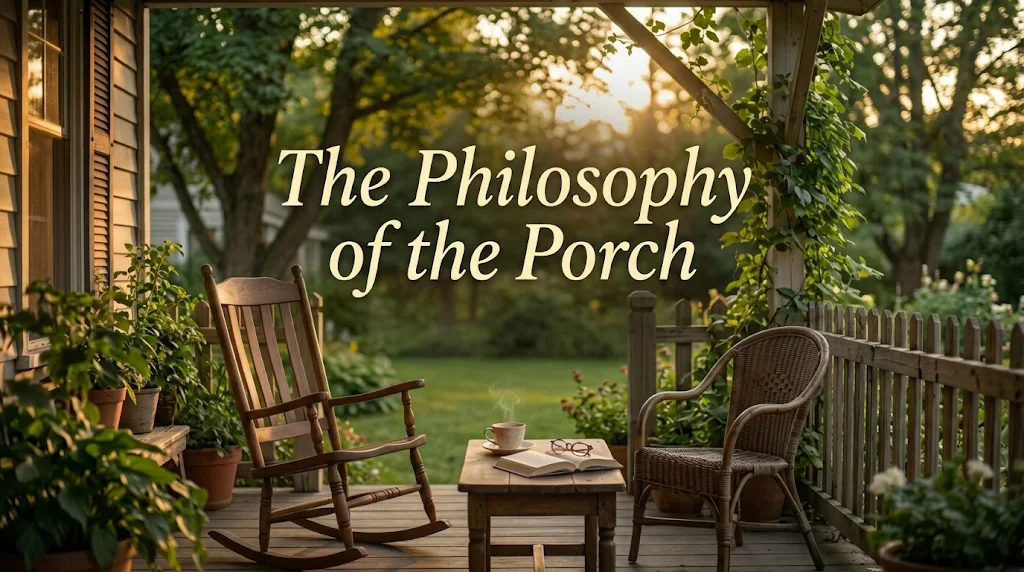
Zeno went on to study under several different philosophers. Eventually, he began teaching his own philosophy. He liked to teach on a colonnaded porch—called a stoa in Greek—which was located on the northern side of the agora, a public space used for trading and gathering—something like a town square in ancient Greece—in Athens. Perhaps that is why his followers were called “the people of the Stoa.” While writing this book, I found that many people had difficulty pronouncing “Stoicism.” So, to make the book’s title more accessible, I called it The Philosophy of the Porch, a direct translation of the word stoa.
After Zeno, other philosophers continued and developed this philosophy, from Greece through to the Roman Empire. They included Chrysippus of Soli, Greece, who is regarded as the second founder of Stoicism; Cato the Younger of Rome, a politician and statesman famous for daring to oppose Julius Caesar; Lucius Seneca of Rome, a philosopher, statesman, and playwright; Musonius Rufus of Rome, who taught philosophy during the reign of Emperor Nero; Epictetus of Greece, who was born enslaved, later gained his freedom, and lived in Rome; and Emperor Marcus Aurelius, known as one of the “Five Good Emperors.”
Stoicism later declined in the early fourth century, when the Roman Empire adopted Christianity as its official state religion. Now, in the twenty-first century, the philosophy is regaining popularity in the Western world through books and presentations that reintroduce it to the public, including works by William Irvine, Tim Ferriss, Ryan Holiday, and Massimo Pigliucci. There is even an annual event called Stoic Week, held around October or November, during which people interested in Stoicism from around the world can reflect on and practice this philosophy together for a week, with guidance provided online.
As I studied Stoicism, I discovered that this philosophy was far from having its head in the clouds or being merely a collection of abstract, “intellectual” concepts. Stoicism is highly practical and can be applied in everyday life. Personally, I found it to offer a better approach to living—a “way of life,” to borrow Father A. Setyo Wibowo, S.J.’s expression—than the teachings of positive thinking. Here is a simple example of how Stoicism has changed my character. In the past, I could turn into a very different person whenever I got caught in traffic. I could become extremely stressed and emotional behind the wheel. (Imagine the Thing from Fantastic Four, but purple instead of orange and without the muscles. Or maybe just Barney in a bad mood.) Even as a passenger who did not have to drive, I would still feel angry whenever I felt “stuck” in traffic. It made me furious, frustrated, and a nuisance to my family. After discovering, studying, and practicing Stoicism, I changed dramatically. Traffic no longer makes me emotional, and I can even feel happy—sometimes to the bewilderment of those around me, especially when I start stroking a chicken’s chest…
The effects of Stoicism on my life have not been limited to situations on the road. Stoicism has helped me live more peacefully each day, without being so easily disturbed by negative things—whether traffic jams, work pressure, or annoying people around me. Having benefited from practicing Stoicism, I want to share it with others through this book. Who knows? The Philosophy of the Porch might help other people as it has helped me. Let’s begin by getting to know Stoicism better!
One thing I discovered while studying Stoicism was how many of its principles overlap with those taught by various religions, parents, our grandparents’ advice, and even traditional Indonesian wisdom. As you read this book, you may think, “Oh, this is the same as what my religion teaches!” or “This sounds like what people used to say in the old days!” or “This is like a quote from so-and-so, the famous person!” Or perhaps you personally know someone who already practices these philosophical principles.
Although I have not read every interpretation of Stoicism out there, I have yet to come across any of its teachings that contradict my religious beliefs. Moreover, because this is a philosophy rather than a religion, it should not create conflicts or clashes with religious teachings. I have not yet found a “religion.” What I have found instead is that it is compatible with—and complementary to—a variety of beliefs.
Stoicism is also not dogmatic. It is not a religion with absolute rules that must never be broken or threats of being sent to hell for failing to follow them. As a philosophy, it is open to debate and can be adapted to each person’s needs. This book focuses more on the basic principles of The Philosophy of the Porch that can help us live our lives amid uncertainty. Ultimately, Stoicism places greater emphasis on putting its teachings into practice and benefiting from them in everyday life than on discussing dogma and texts.
What Is the Main Goal of the Philosophy of the Porch?
Let’s begin with what is NOT the goal of Stoicism. Stoicism is not intended as a quick way to obtain external things, such as success, a romantic partner, the approval of others, a business idea, a wife—your own, not someone else’s—a luxury car, millions of dollars in investment for your start-up, or genius children. This is what sets it apart from many of today’s popular self-help teachings.
The main things Stoicism seeks to achieve are:
- Living free from negative emotions—sadness, anger, jealousy, suspicion, and so on—and attaining a peaceful life. This peace can be achieved only by focusing on the things within our control.
- Living a life that cultivates virtue. The Indonesian term for virtue is keutamaan, or “excellence.” Stoicism identifies four principal virtues:
- Wisdom: the ability to make the best decisions in any situation.
- Justice: treating others fairly and honestly.
- Courage: the courage to do what is right and stand by sound principles. This is not “courage” in the trivial sense of daring to go into a haunted house, but the courage to do what is right. Don’t be offended when I recount the lives of the Stoic philosophers, because they were indeed brave—though perhaps they, too, would have been terrified by a kuntilanak, an Indonesian female ghost. Who knows?
- Temperance: discipline, moderation, propriety, and self-control over desires and emotions.
While studying Stoicism, I discovered that “happiness,” in the everyday sense of the word, is not the goal this philosophy pursues. Stoic philosophers place greater emphasis on controlling negative emotions and cultivating virtue. The English word virtue comes from the Latin virtus, which in turn was derived from the Greek arete. Some meaning is inevitably lost in this chain of translation, so it is important for us to understand the original meaning of arete.
In his book Stoicism and the Art of Happiness, Donald Robertson explains that arete means “fulfilling our nature and essential character as well as possible, in a healthy way.” In my own words, this means living as we were meant to. It may be clearer if we look at how arete was used in its original context. A horse that is strong, resilient, and able to run fast could be said to possess arete. In other words, a strong horse that runs fast is the best possible horse, fulfilling its nature and essence as a horse.
The Philosophy of the Porch believes that all these virtues and qualities should come from within us. As long as we continue to depend on our ability to control negative emotions, cultivate virtue, and live by our values, a peaceful, tranquil, and resilient life will follow as a consequence.
However, we must first understand what our nature and purpose as human beings actually are. This is what the next chapter will discuss.
One reason I like this philosophy is that ANYONE can practice it without having to depend on attributes such as wealth, academic achievement, innate intelligence, skin color, ethnicity, career, profession, or any other label. Stoicism is an inclusive philosophy that transcends material possessions, popularity, academic qualifications, and long lists of titles. These things are not its definition of success, nor are they proof that someone practices Stoicism. This is evident in the diverse backgrounds of the Stoic philosophers, who included politicians, an emperor, a merchant, and an enslaved person.
“A practicing Stoic should feel a lasting joy, a profound joy, because he is able to find happiness within himself and desires no joy other than that which comes from within.”—Seneca, On the Happy Life
The goal of controlling negative emotions is highly relevant to life today, with all its uncertainty. After reading the results of the “National Worry Survey,” this ancient philosophy seems just as relevant now as it was more than 2,000 years ago. In the article “Why Stoicism Matters Today,” Kare Anderson offers several reasons why Stoicism remains relevant today.
- Stoicism Was Written for—and to Confront—Difficult Times. Stoicism emerged during a time of war and crisis in Greece. This philosophy does not promise material prosperity or peace in the afterlife, but rather a firm inner peace and resilience for life in the here and now. It is a peace that is firmly rooted within us, rather than in external things that can be destroyed or taken away.In an era when hoaxes, fake news, and hate speech are widespread on social media, and when we are increasingly prone to baper—taking things personally—this ancient philosophy and causing divisions in society, Stoicism seems just as relevant to Indonesia today as it was to Greece and Rome 2,000 years ago.
- Stoicism Was Made for Globalization. Stoicism may have been the first Western philosophy to teach universal brotherhood. In a world that seems increasingly polarized between “left” and “right,” “conservative” and “liberal,” and divided by ethnic and religious identities, a philosophy that teaches that “we are all brothers and sisters in humanity” is greatly needed. This also seems particularly fitting for Indonesia’s increasingly heated political climate, in which divisive labels and barriers between people appear to be growing stronger.
- Stoicism Is a Philosophy of Leadership. Leadership here is not limited to leading a team, an organization, or a country. It begins with leading ourselves. Stoicism teaches us to prioritize self-control before trying to control the lives and people around us. It equips leaders to remain resilient in failure and humble in success. These qualities are useful for everyone, not just those who hold official positions.
Ryan Holiday’s book The Daily Stoic discusses several well-known people who are known—through their own statements or writings—to have studied and practiced Stoicism in their lives. They include former U.S. president Bill Clinton, actress Anna Kendrick, actor Tom Hiddleston, author J. K. Rowling, and Nassim Nicholas Taleb, author of The Black Swan.
The Philosophy of the Porch is not intended to be an official introduction to Stoicism, much less its definitive reference. This little book could not possibly explain the philosophy in its entirety. For that reason, I have selected only the core ideas that I feel are the most accessible and relevant to everyday life, combining them with my personal insights and the perspectives of practitioners in relevant fields.
I encourage you to read more deeply and discover this philosophy more fully for yourself, whether through contemporary writings about it or by reading the works of its philosophers directly—although, unfortunately, almost all the literature I have read is still in English. Think of this book as an “appetizer” to Stoic philosophy. Hopefully, this “appetizer” will leave you eager to enjoy the “main course”: writings on Stoicism by both its original thinkers and contemporary authors.
Let’s begin exploring The Philosophy of the Porch!